
Your needs, this model
Does it fit your priorities?
How does the D20A10B straighten hair if it has no plates?
The current product page calls it a dryer, not a flat iron. Its exact-page-linked manual names the SlipStream straightening attachment, directs the user to draw a section through it, move the dryer along the section, and hold the ends taut to dry in a straightened manner. No plate width is stated, so this cannot satisfy a numeric maximum-plate-width requirement.
Explore this need in the finder →Can I select heat while styling with the D20A10B?
Yes. The exact product page and D20A-series manual list three selectable heat settings, two speeds and a cool-shot control. This supports adjustable heat in the finder, but neither source gives a numeric plate or airflow temperature range.
Explore this need in the finder →Can I assume that the D20A10B works on 220/240 V while travelling?
No. The product page lists 120 V, while the linked D20A-series guide says 125 VAC, 60 Hz and warns not to use the appliance in 220/240-volt countries. It does not document universal voltage; check the exact rating plate and do not treat a plug adapter as voltage conversion.
Explore this need in the finder →The Remington Pro Wet2Style Dryer (D20A10B) is not a conventional flat iron, but it has a specific straightening function worth distinguishing from an ordinary dryer. Its current product page lists a SlipStream attachment for pre-straightening, and the linked D20A-series manual names that piece a “SlipStream Straightening Attachment” and explains how to dry sections in a straightened manner. That documented air-assisted operation is why this assessment includes the exact configuration as a hybrid straightener. It uses directed air, not a pair of heated plates. This is source-based analysis, not a use test.
What the straightening attachment actually does
The manual starts with towel-dried, detangled hair. Its basic drying sequence uses higher heat and speed to remove moisture, then tells the operator to lower both to desired settings once hair is almost dry and begin styling in manageable sections. For the SlipStream attachment, the booklet says to hold a section so hair is drawn through the opening, move the dryer up and down the section, focus airflow at the roots, and hold the ends taut to dry in a straightened manner. The tool therefore combines drying and guided section styling; it is not an iron intended to clamp a plate over damp hair.
That distinction matters when comparing it with Remington’s Pro Wet2Style S25A10A, a separate 1¾-inch flat iron with vented plates and its own damp-hair directions. The D20A10B has no plate width to compare with the S25A10A or with a one- or two-inch iron. The D20’s straightening path depends on airflow, the supplied attachment, preparation and how a section is guided. If a measurable plate width is essential, this model cannot meet that request; the finder deliberately leaves its plate-width fact unknown rather than treating a brush or nozzle dimension as a plate measurement.
Attachments and package checks
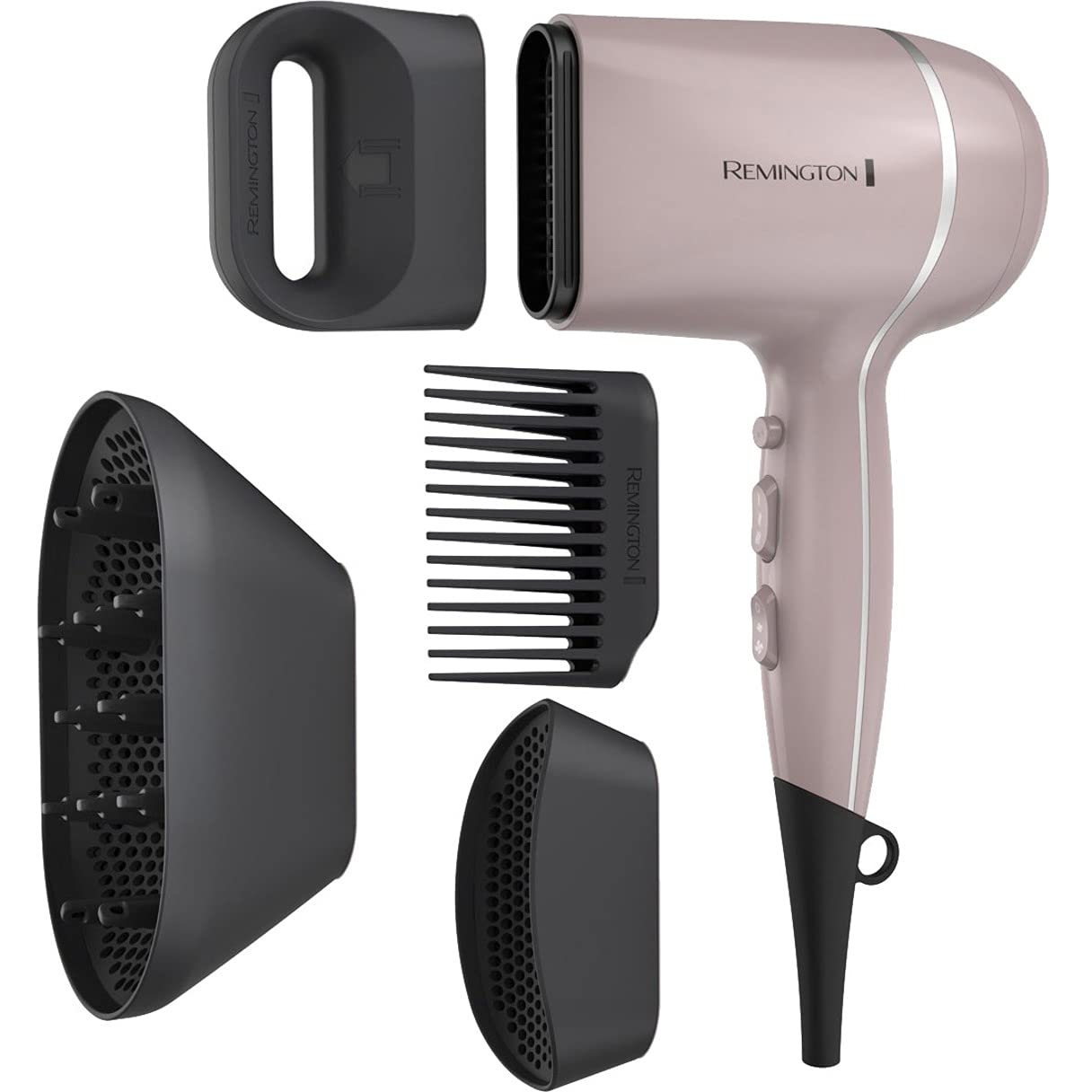
The exact D20A10B page lists four attachments: Detangler, Blowout Boost, Diffuser and SlipStream. The manual labels a “Straightening/Detangling Pick” and separately describes the SlipStream straightening piece. It also describes Blowout Boost used with a round brush underneath the dryer, so do not assume a brush is included unless the seller’s exact package says so. The official primary photo shows the dryer with several attachments, but an image is not a complete contents list. Confirm D20A10B on the item and check that the attachments needed for the intended arrangement are in the offer.
Each attachment points to a different routine. The diffuser is described for enhancing natural curls or texture. Blowout Boost shapes a section with a round brush. The pick detangles or guides hair, while the SlipStream attachment is the one tied to the manual’s straightened-drying steps. Those functions are not interchangeable, and an ordinary concentrator or diffuser should not be represented as the product’s straightening mechanism.
Three heat settings are not three plate temperatures
The official page and booklet document three heat settings, two speeds and a cool-shot control. That makes the dryer’s heat selectable, so it fits an adjustable-heat requirement in the finder. Neither source publishes a degree range for these controls, however. There is no supported numeric plate setting, plate-temperature range or heat-up time to compare with a flat iron. The page’s “1875W” figure is a power specification, not a hair-surface temperature.
The maker describes faster styling and less damage than drying and styling with standard Remington tools, and its footnote ties the comparison to the SlipStream attachment. Those are manufacturer claims, not a guarantee of an individual result. No independent measurements or comparative tests were conducted for this assessment, and the wording does not establish that every hair type, technique or section will take less time or experience less heat exposure.
Outlet and reach are separate questions
The product page lists 120 V. Its linked D20A-series manual’s rating line says 125 VAC, 60 Hz, then warns not to use the appliance in countries with 220/240-volt systems and says to use only 110/120-volt systems. I keep those published voltage statements visible rather than converting them into a universal-voltage claim. Check the rating plate on the actual appliance and do not treat a plug adapter as voltage conversion. The guide also warns against a voltage converter and extension cord. Numeric cable length is not stated, so neither reach nor suitability for a particular outlet distance can be promised.
The official U.S. recall notice checked for this assessment names the exact Remington D3190DCDN hair dryer by rating-plate reference; it does not name D20A10B. The similar D3190NA three-piece dryer-set listing is a different code. Always verify the full model code and current notice before buying or using a tool, rather than generalizing a notice from a product-family prefix.
Identity caveats and who should compare it
The current Hair Care Tools card and the exact product page’s variant information identify D20A10B. The URL handle ends in “d20a10a,” while the linked booklet identifies the broader D20A series. The primary page, not the URL text alone, establishes the retail code used here; the family manual supports operation but does not confirm the exact suffix. Before buying, compare the unit label, manual and package to D20A10B, especially if a seller page uses a different code.
This dryer-based hybrid may be relevant when the desired operation is corded, adjustable-heat styling on towel-dried hair with the maker’s SlipStream attachment. It is a poor fit for someone who needs a verified plate width, numeric heat setting, universal voltage, cordless use or a published minimum cable length. The sensible comparison is not “which iron is fastest,” but whether the airflow attachment and two-stage drying routine match the actual process you want. Follow the exact manual for preparation, outlet safety, attachment handling and care; the published feature list does not replace those instructions.
Key specifications
Key details at a glance
| User-adjustable heat documented | Yes |
|---|---|
| Heating system | Hot-air drying with slipstream straightening attachment; no straightening plates |
| Universal-voltage support stated | No |
| Corded operation | Yes |
| Manufacturer says use on dry hair | No |
Use the exact model’s instructions for operating limits, supplied equipment and version differences.
Sources for this review
Sources for this assessment
- Remington official U.S. Hair Care Tools collection, 47-card inventory
- Remington Pro Wet2Style Dryer, exact product page and D20A10B variant code
- Exact-page-linked D20A-series Wet2Style Dryer Use and Care Guide
- Remington official U.S. Product Recalls page; current notice names exact D3190DCDN only
- Exact D20A10B product-page primary gallery image

Check your own fit against the published facts
Use the finder to compare plate width, heat controls, cord and voltage needs. A fit is not a performance guarantee.